

The Asymptotic Model of Intergroup Contact
After the conference in Karlsruhe
Paulina
7/12/20269 min read


Conference season is in full swing, so why not share some of my presentations with a wider audience? Below, I briefly discuss the results of a study on the asymptotic model of intergroup contact, which I presented a few weeks ago in Karlsruhe at the Intergroup Contact Research Network conference.
NOT A STRAIGHT LINE, BUT A CURVE
One of the most widespread assumptions in research on intergroup contact is that the more often we meet members of an outgroup, the less prejudiced we become towards that group. This relationship is usually represented as linear: each successive interaction is assumed to bring roughly the same small improvement in attitudes.
This assumption is intuitive and supported by the literature. At the same time, research on the psychology of interaction suggests that contact with unfamiliar members of an outgroup can initially evoke stress, uncertainty, and tension. During such conversations, we may not know how to behave, worry about making a social blunder, and find that the interaction requires more effort. Rather than immediately reducing prejudice, initial contacts may therefore temporarily increase it.
The asymptotic model of intergroup contact, developed by Cara MacInnis and Elizabeth Page-Gould, offers a solution to this apparent contradiction. According to the model, individual interactions are units of intergroup contact, and their effects on attitudes towards outgroups do not have to remain constant. Initial encounters may be unstable and stressful, and may even lead to a temporary increase in prejudice. Later, as experience accumulates, reductions in prejudice should become increasingly apparent. After some time, however, the contact–prejudice curve begins to flatten: further interactions may continue to improve attitudes, but each is associated with only a small additional change.
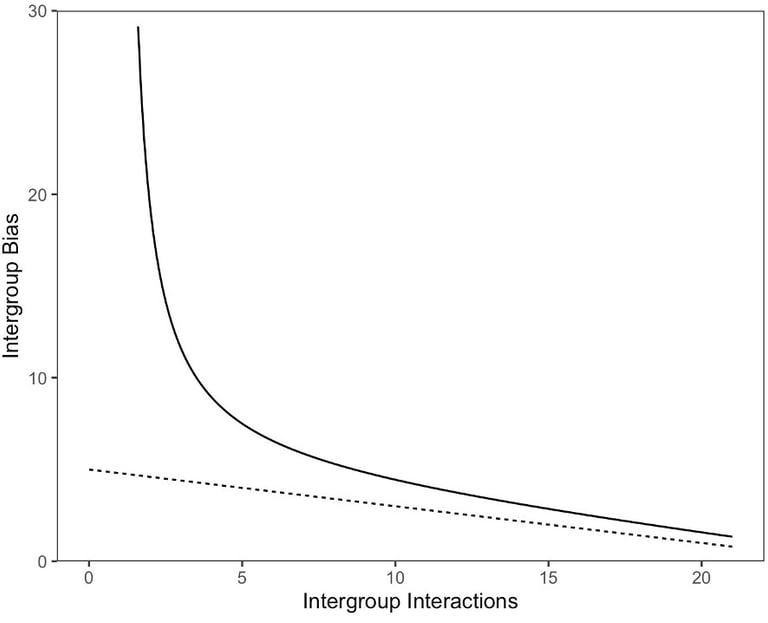
The model therefore assumes that the relationship between contact and prejudice does not resemble a straight line. Instead, it takes the form of a curve that changes rapidly at first and then gradually approaches a stable trend. The authors of the model call the transition to this more stable phase the “contact threshold”. This does not have to be a single specific point that is identical for everyone. Rather, it refers to the stage at which a person has accumulated enough experience for subsequent encounters to stop feeling new and difficult.
Unusually for a theory in social psychology, the asymptotic model of intergroup contact has a strictly specified mathematical representation: the relationship between the cumulative number of interactions across a person’s lifetime and their attitudes towards outgroups is described by a formula containing three parameters, each with a precise theoretical meaning.


The first parameter, contact effect, determines the slope of the long-term trend. It shows what happens to prejudice when the number of intergroup experiences is already relatively high and the contact threshold has been reached. If contact reduces prejudice, the value of this parameter should be negative.
The second parameter, default intergroup bias, refers to the predicted level of prejudice in a person who has no experience of contact with a given outgroup.
The third parameter, rate, describes the curved part of the function. It indicates how quickly a person moves from the unstable period of initial encounters to the phase in which the relationship between contact and prejudice becomes more regular.
In addition to being components of the formula for the asymptotic curve, default intergroup bias and contact effect also describe the oblique asymptote of the contact–prejudice curve. Because of the shape of the formula, as well as the large fluctuations in attitudes associated with a first encounter, the asymptotic curve reflects only situations in which the first interaction has already taken place.
ALTERNATIVE PARAMETER VALUES
In the classical version of the model, we expect a downward-sloping curve that gradually flattens. This would mean that the greatest improvement in attitudes occurs relatively early in the accumulation of experience, while later contacts bring progressively smaller benefits. In terms of parameter values, we therefore expect a negative contact effect, a positive default level of intergroup bias, and a positive rate, with the sum of the latter two greater than zero.
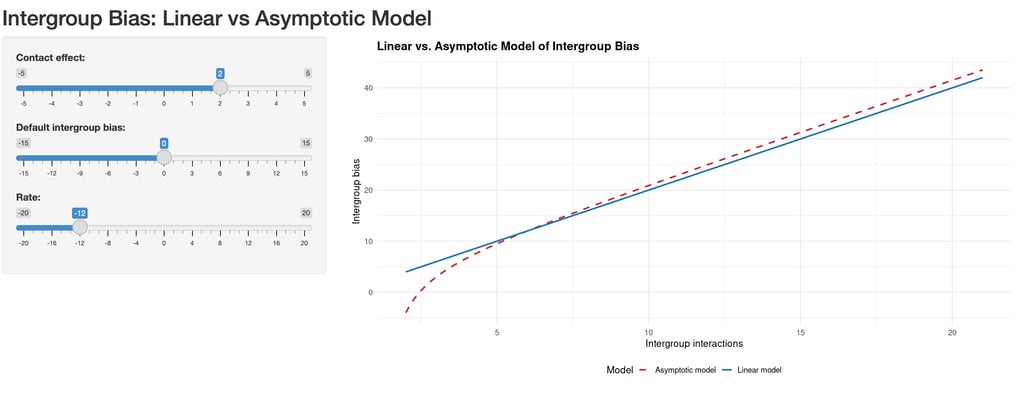
However, the model can also describe other scenarios that were not considered by its authors. If contact is unpleasant, conflictual, or threatening, a greater number of interactions may be associated with increased prejudice, implying a positive contact effect. When the sum of the parameters equals zero, the function becomes linear. If that same sum is negative, the curve approaches the asymptote from below, which corresponds to an initial increase in prejudice. All of these situations are conceivable in the real world — parameter values that differ from the default expectations do not necessarily mean that the formula presented above fails to represent reality adequately. What may be incorrect, instead, is the assumption that accumulating intergroup experiences will lead only to reductions in prejudice, or at most to stagnation.
Those interested in how parameter values affect the shape of the contact–prejudice curve can use a simple R Shiny application that I made available here.
WHY HAS IT BEEN TESTED SO RARELY?
Despite its theoretical elegance, the asymptotic model has received relatively few direct empirical tests. One reason is its methodological demands. To study nonlinear change reliably as successive interactions occur outside the laboratory, it is not enough to ask participants once how often they have contact with members of another group. Repeated measurements of the same individuals are needed, ideally day after day. Studies of this kind are costly and demanding for participants. They also require statistical models capable of accounting simultaneously for the nonlinear shape of the relationship and the hierarchical structure of the data, in which multiple observations come from the same person. Such techniques are not a compulsory part of even doctoral training programmes.
In addition, the asymptotic curve is intended to describe the effect of cumulative interactions with outgroup members across a person’s entire lifetime. In situations where groups have already coexisted in the same environment for some time, it is unrealistic to expect that a participant with no previous experience of contact with the outgroup will spontaneously begin interacting with its members during a two-week diary study. Outside the laboratory, such sudden changes in the amount of contact tend to occur during periods of rupture, such as large-scale population movements (e.g. following the outbreak of war) or changes in one’s social environment resulting from individual circumstances (e.g. starting university in another country).
STUDYING CONTACT BETWEEN POLES AND UKRAINIANS
In our study, we set out to conduct a direct test of the asymptotic model of intergroup contact. We also wanted to examine whether the shape of the contact–prejudice relationship depends on how these constructs are measured and on the status of the ingroup.
To standardise the effect of the geographical and social contact context, we conducted the study among Polish and Ukrainian residents of Warsaw. After the beginning of Russia’s full-scale invasion of Ukraine in 2022, the number of Ukrainians living in the city increased substantially. During data collection, in June and July 2025, they accounted for approximately 10–15% of Warsaw’s population.
Participants installed a mobile application on their phones and, for 21 consecutive days, received invitations to complete a short questionnaire. The surveys were available in Polish, Ukrainian, and Russian.
Each day, we asked about interactions with members of the other group and attitudes towards that group. Participant engagement was high: they completed 85.37% of all scheduled surveys.
NOT ALL CONTACT IS THE SAME
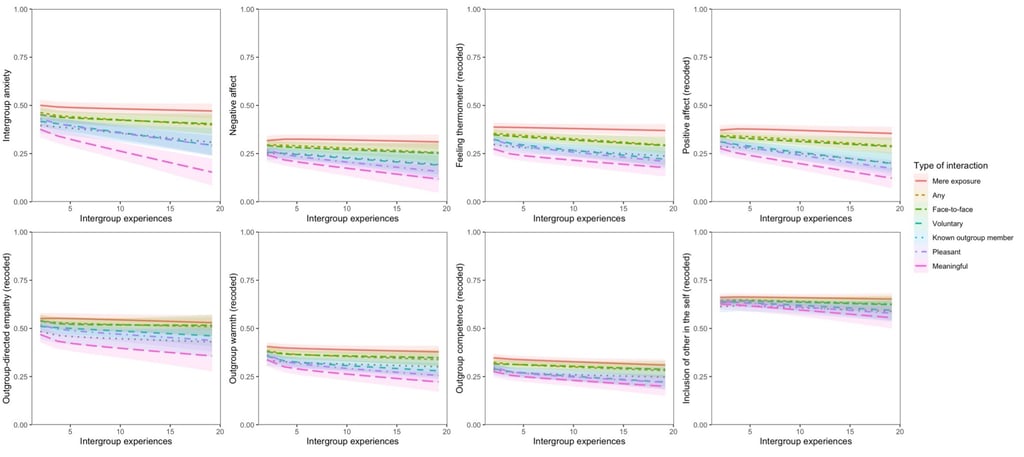
We did not want to treat all intergroup experiences as equivalent. We therefore distinguished seven types:
mere exposure, that is, being in the presence of an outgroup member without interacting with that person,
any interaction,
face-to-face interaction,
voluntary interaction,
interaction with someone already known,
pleasant interaction,
meaningful interaction.
Participants answered a series of questions about the longest intergroup experience they had had that day. On the basis of these responses, we determined whether each of the seven types of experience had occurred.
We then calculated the cumulative number of intergroup experiences within each of the seven categories. For example, if a participant had a meaningful interaction on the first, fourth, and fifth days of the study, their cumulative score would be one, one, one, two, and three on days 1–5, respectively. This allowed us to observe how attitudes changed as successive experiences accumulated.
THE EIGHT SHADES OF PREJUDICE
We measured attitudes towards the other group in eight ways. We analysed:
intergroup anxiety,
negative emotions,
feeling thermometer ratings,
positive emotions,
empathy towards the outgroup,
perceived warmth,
perceived competence,
inclusion of outgroup members in the self.
Such a broad set of indicators was important because contact does not necessarily affect all aspects of attitudes in the same way. It may reduce anxiety quickly while changing competence stereotypes more slowly. It may increase positive emotions without affecting feelings of closeness to the same extent. A single general measure of prejudice could conceal these differences.
Before the analyses, we coded the data so that higher values always indicated greater prejudice or greater distance from the outgroup.
MODEL EVALUATION CRITERIA
In total, we estimated 56 Bayesian multilevel models — one for each combination of seven types of contact and eight indicators of prejudice.
We regarded results as consistent with the asymptotic model when three conditions were met.
First, the contact effect had to be negative and different from zero. A greater number of experiences should therefore be associated with a lower level of prejudice.
Second, the relationship should take the form of a monotonically decreasing curve that gradually flattens.
Third, the asymptotic model should predict the data better than a simpler linear model.
The criteria defined in this way were relatively strict. It was not enough for the graph merely to resemble a curved line or for one of the parameters to have the expected sign.
CONTACT QUALITY MATTERS MOST
The asymptotic contact model received support in 22 of the 56 cases analysed. Importantly, results consistent with the model appeared primarily for pleasant and meaningful interactions. This suggests that simply accumulating contact of any kind may not be enough. The most characteristic nonlinear improvement in attitudes occurred when encounters were positive in quality or personally important to participants.
We found no evidence supporting the asymptotic model when the outcome variables were empathy towards the outgroup and inclusion of its members in the self. These aspects of intergroup relations may change according to a different dynamic. It is also possible that they require more intensive, long-lasting, or reciprocal relationships than can be observed during a three-week diary study.
DOES GROUP STATUS MATTER?
Analyses of differences between Poles and Ukrainians are still ongoing, so these results should be treated as preliminary.
Initial findings suggest that the long-term effect of contact may be stronger among Ukrainians than among Poles. This would be surprising, because previous research often suggests that contact improves attitudes more strongly among majority-group members than among minority-group members.
This result should, however, be interpreted cautiously. The findings may have been influenced by the campaign preceding the presidential election (the data were collected from early June to mid-July 2025), during which anti-Ukrainian themes were highly salient.
CONTACT DOES NOT WORK THE SAME WAY AT EVERY STAGE
To sum up, our findings suggest that treating the relationship between contact and prejudice as invariably linear is, at the very least, an oversimplification. This does not mean that classical research on contact is wrong. The small, stable effect observed in cross-sectional studies may accurately describe a later phase of the process, in which people already have relatively extensive intergroup experience. It may not, however, capture what happens during the first encounters, when interactions are still new, stressful, and unstable.
At the same time, the asymptotic shape of the relationship between contact and prejudice did not emerge in all analyses. Its occurrence depended both on the type of contact and on the aspect of prejudice being measured. According to our results, the asymptotic model is not a universal answer to every question about intergroup contact. Rather, it provides a theoretically grounded and empirically testable alternative to automatically assuming that this relationship is linear.
The main conclusion is simple: the effect of contact may change with experience. The first, tenth, and hundredth encounter do not necessarily have the same significance. If we want to better understand how intergroup relations reduce prejudice, we should analyse not only how much contact people have, but also what kind of contact it is and at what stage of accumulating experience they are.
Of course, the project as a whole has its limitations — the most important of which is that the study was not conducted during a period of rupture, when the largest number of refugees arrived in Poland immediately after the outbreak of the full-scale war. It was probably during that period that some of our participants first came into contact with members of the outgroup. Had we had data collected at that time, we might have observed less “flat” curves, particularly for less involving forms of contact. By June–July 2025, most participants had already had those initial interactions — it is possible that we captured the asymptotic curve only once it had already begun to flatten, resulting in a relatively small difference in the fit of the linear and asymptotic models to the data. These hypotheses could be tested by conducting a similar study in a context in which a rupture had only just occurred.